> ## Documentation Index
> Fetch the complete documentation index at: https://docs.searchable.com/llms.txt
> Use this file to discover all available pages before exploring further.
# Understanding Scores
> Learn how Searchable calculates and interprets your optimization scores
Ask your Searchable Agent for help if you want to understand or dig deeper into any of your scores.
## Score Overview
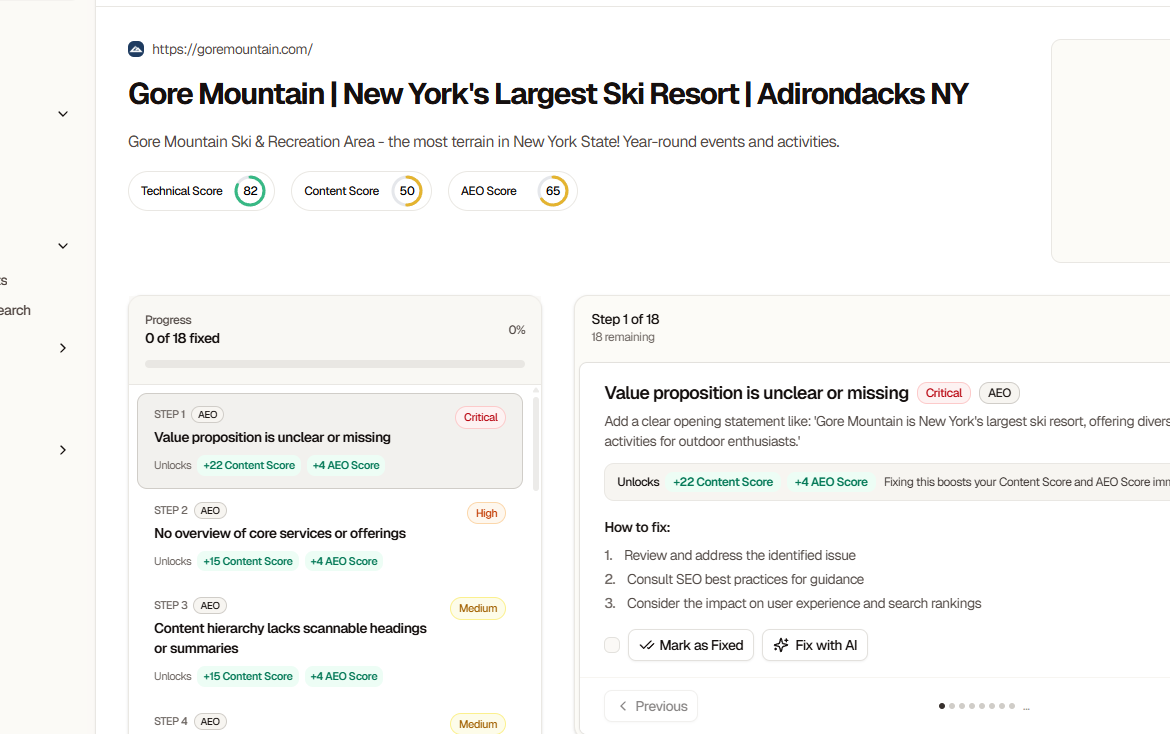
Searchable uses a comprehensive scoring system (0-100) to measure your site's optimization across multiple dimensions. Each score provides actionable insights into specific aspects of your online presence.
Site performance, speed, and technical SEO
Content quality, structure, and optimization
Answer Engine Optimization readiness
Combined weighted score
## Technical Score (0-100)
### What It Measures
Your Technical Score evaluates the technical foundation of your website that affects both traditional search engines and AI crawlers.
 ### Components & Weighting
**Page Speed (30%)**
* First Contentful Paint (FCP)
* Largest Contentful Paint (LCP)
* Time to Interactive (TTI)
* Total Blocking Time (TBT)
**Mobile Optimization (25%)**
* Mobile-friendliness
* Responsive design
* Touch target sizing
* Viewport configuration
**Core Web Vitals (20%)**
* LCP (Largest Contentful Paint)
* FID (First Input Delay)
* CLS (Cumulative Layout Shift)
**Technical SEO (15%)**
* XML sitemap presence and validity
* Robots.txt configuration
* Canonical tags
* HTTPS implementation
* Structured data
**Crawlability (10%)**
* Internal linking structure
* Broken links
* Redirect chains
* URL structure
* Server response codes
### Score Interpretation
| Score Range | Status | What It Means |
| ----------- | --------- | ---------------------------------------------------------------- |
| 90-100 | Excellent | Technical foundation is solid. Minor optimizations only. |
| 70-89 | Good | Generally well-optimized with some room for improvement. |
| 50-69 | Fair | Several technical issues affecting performance and crawlability. |
| 30-49 | Poor | Significant technical problems that need immediate attention. |
| 0-29 | Critical | Major technical issues severely impacting site performance. |
### How to Improve
**Quick Wins:**
* Compress and optimize images
* Enable browser caching
* Minify CSS, JavaScript, and HTML
* Use a CDN for static assets
* Reduce server response time
**Advanced:**
* Implement lazy loading for images
* Use modern image formats (WebP, AVIF)
* Defer non-critical JavaScript
* Optimize web fonts
**Quick Wins:**
* Test on multiple mobile devices
* Ensure text is readable without zooming
* Make buttons and links touch-friendly (min 48px)
* Avoid intrusive popups
**Advanced:**
* Implement responsive images
* Optimize for different screen sizes
* Test on slow network conditions
**For LCP (\< 2.5s):**
* Optimize largest element loading
* Preload important resources
* Reduce server response time
**For FID (\< 100ms):**
* Minimize JavaScript execution
* Break up long tasks
* Use web workers for heavy computations
**For CLS (\< 0.1):**
* Set size attributes for images/videos
* Reserve space for ads
* Avoid inserting content above existing content
**Quick Wins:**
* Create and submit XML sitemap
* Implement canonical tags
* Add structured data (Schema.org)
* Fix broken links
**Advanced:**
* Optimize crawl budget
* Implement hreflang for international sites
* Use semantic HTML5 elements
* Optimize URL structure
Use the Issues tab to see specific technical problems. Searchable prioritizes fixes by impact.
## Content Score (0-100)
### What It Measures
Your Content Score evaluates the quality, structure, and optimization of your content for both readers and AI models.
### Components & Weighting
**Content Quality (30%)**
* Depth and comprehensiveness
* Original, valuable information
* Clear, well-written text
* Proper grammar and spelling
* Content-to-code ratio
**Keyword Optimization (25%)**
* Target keyword usage
* Keyword density (not overstuffed)
* LSI keywords and semantic relevance
* Keyword placement (title, headings, first paragraph)
**Content Structure (20%)**
* Proper heading hierarchy (H1, H2, H3)
* Paragraph length and readability
* List and table usage
* Content organization
* Table of contents for long content
**Internal Linking (15%)**
* Internal links quantity
* Relevant anchor text
* Link depth from homepage
* Topical clustering
**Meta Data (10%)**
* Title tag optimization
* Meta description quality
* Header tags (H1-H6)
* Image alt text
* Open Graph tags
### Score Interpretation
| Score Range | Status | What It Means |
| ----------- | --------- | -------------------------------------------------------------- |
| 90-100 | Excellent | Content is comprehensive, well-optimized, and highly valuable. |
| 70-89 | Good | Quality content with minor optimization opportunities. |
| 50-69 | Fair | Content needs improvement in structure or depth. |
| 30-49 | Poor | Thin or poorly optimized content requiring significant work. |
| 0-29 | Critical | Very thin or missing content. Major rewrite needed. |
### How to Improve
**Quick Wins:**
* Add more detailed explanations
* Include examples and case studies
* Update outdated information
* Add visual elements (images, videos)
* Improve readability (shorter sentences, clear language)
**Advanced:**
* Conduct original research
* Interview industry experts
* Create comprehensive guides
* Add unique data and statistics
**Quick Wins:**
* Include target keyword in title
* Use keyword in first 100 words
* Add keyword to at least one H2
* Use natural variations throughout
**Advanced:**
* Research and use LSI keywords
* Target long-tail variations
* Analyze top-ranking content
* Avoid keyword stuffing (2-3% density max)
**Quick Wins:**
* Use clear heading hierarchy
* Break long paragraphs (3-4 sentences max)
* Add bullet points and numbered lists
* Include a table of contents for long articles
**Advanced:**
* Create content clusters around topics
* Use jump links for navigation
* Implement FAQ sections
* Add summary boxes
**Quick Wins:**
* Link to relevant related content
* Use descriptive anchor text
* Add 3-5 internal links per page
* Fix broken internal links
**Advanced:**
* Create topic clusters with pillar pages
* Implement breadcrumbs
* Build a hub-and-spoke structure
* Use contextual linking
## AEO Score (0-100)
### What It Measures
Answer Engine Optimization (AEO) Score evaluates how well your content is optimized for AI-powered search engines and language models like ChatGPT, Claude, and Perplexity.
AEO is the evolution of SEO for the AI era. It focuses on making your content easily understood and cited by AI models.
### Components & Weighting
**Structured Data (25%)**
* Schema.org markup implementation
* Rich snippets optimization
* Knowledge graph eligibility
* Entity markup
**Answer Format (25%)**
* Clear, direct answers to questions
* Featured snippet optimization
* FAQ sections
* How-to formats
**Citation Worthiness (20%)**
* Authoritative content
* Proper sourcing and citations
* Expert author bios
* Trustworthy references
**Semantic Richness (20%)**
* Entity recognition
* Topic depth and breadth
* Related concepts coverage
* Context clarity
**AI Accessibility (10%)**
* Clean HTML structure
* Logical content flow
* No excessive advertising
* Fast loading
### Score Interpretation
| Score Range | Status | What It Means |
| ----------- | --------- | ------------------------------------------------------------------ |
| 90-100 | Excellent | Highly optimized for AI engines. Likely to be cited frequently. |
| 70-89 | Good | Well-formatted for AI with some optimization opportunities. |
| 50-69 | Fair | Basic AI compatibility. Needs structured data and clearer answers. |
| 30-49 | Poor | Difficult for AI to parse. Missing key AEO elements. |
| 0-29 | Critical | Not AI-friendly. Major restructuring needed. |
### How to Improve
**Quick Wins:**
* Add Organization schema
* Implement Article schema
* Add FAQ schema for Q\&A content
* Include Product schema for e-commerce
**Advanced:**
* Add HowTo schema for guides
* Implement Review schema
* Use Event schema for events
* Add LocalBusiness schema
```json Example: Article Schema theme={null}
{
"@context": "https://schema.org",
"@type": "Article",
"headline": "Your Article Title",
"author": {
"@type": "Person",
"name": "Author Name"
},
"datePublished": "2025-01-15",
"image": "https://example.com/image.jpg",
"publisher": {
"@type": "Organization",
"name": "Your Company",
"logo": {
"@type": "ImageObject",
"url": "https://example.com/logo.png"
}
}
}
```
**Quick Wins:**
* Start with clear, concise answers
* Use question-based headings
* Create FAQ sections
* Format lists and steps clearly
**Advanced:**
* Target featured snippet formats
* Create comprehensive Q\&A content
* Use definition lists for terminology
* Add summary boxes at the top
**Quick Wins:**
* Add author bios with credentials
* Cite reputable sources
* Link to original research
* Update content regularly
**Advanced:**
* Publish original research
* Get cited by authoritative sites
* Build topic authority
* Demonstrate E-E-A-T (Experience, Expertise, Authoritativeness, Trust)
**Quick Wins:**
* Cover related subtopics comprehensively
* Use entity-rich language
* Define technical terms
* Create glossaries
**Advanced:**
* Build comprehensive topic clusters
* Answer related questions
* Cover the full topic ecosystem
* Use natural language variations
## Overall Health Score
### Calculation
Your Overall Health Score is a weighted average of all component scores:
```
Overall Health = (Technical × 0.30) + (Content × 0.35) + (AEO × 0.35)
```
### Why These Weights?
* **Technical (30%)**: Foundation must be solid, but not everything
* **Content (35%)**: Slightly higher weight as it's what users and AI consume
* **AEO (35%)**: Critical for AI visibility in the modern search landscape
### Tracking Progress
**View historical trends:**
* Track scores over time (all plans)
* Data retention: Starter (3 months), Professional (12 months), Agency & Custom (unlimited)
* Compare time periods
* Track after making changes
* Export historical data
**Best Practices:**
* Check scores after each site update
* Monitor trends over weeks, not days
* Focus on improving weakest score first
* Aim for balanced improvement across all scores
## Score Factors Not Included
Searchable scores focus on controllable, measurable factors. We intentionally exclude:
* Domain age and history
* Raw traffic numbers
* Social media engagement
* Backlink quantity (only quality and relevance)
These factors matter for SEO but are either uncontrollable or beyond the scope of content optimization.
## Frequently Asked Questions
Scores update after each audit completes. All plans include continuous monitoring:
* **Starter**: Scores update as audits run within your monthly allocation (25 pages)
* **Professional**: Higher audit capacity (100 pages) for more frequent updates
* **Agency**: 500-page allocation with dedicated success monitoring
* **Custom**: Tailored allocations with SLA-backed updates
Set audit frequency in your project settings based on your needs and plan limits.
Possible reasons:
* Competitor improvements (relative scoring)
* New technical issues discovered
* Algorithm updates in our scoring model
* Server performance degradation
* Third-party script issues
* New pages with poor performance are added to the website
Yes! Many improvements help multiple scores:
* Adding structured data helps both Content and AEO
* Improving page speed helps Technical and user experience
* Better content helps Content, AEO, and engagement
Focus on issues that impact multiple scores first.
* **Technical**: 85+ is achievable for most sites
* **Content**: 80+ with quality content and optimization
* **AEO**: 75+ once structured data is implemented
* **Overall**: 80+ is excellent, 90+ is elite
Focus on consistent improvement rather than perfection.
Higher scores generally mean better AI visibility, but it's not 1:1. Other factors include:
* Brand recognition
* Content topic relevance
* Citation network
* User engagement
Scores provide a strong foundation, but prompt strategy matters too.
## Next Steps
See specific problems affecting your scores
Improve AI visibility beyond technical scores
Generate fresh scores for your site
Connect tools for deeper insights
### Components & Weighting
**Page Speed (30%)**
* First Contentful Paint (FCP)
* Largest Contentful Paint (LCP)
* Time to Interactive (TTI)
* Total Blocking Time (TBT)
**Mobile Optimization (25%)**
* Mobile-friendliness
* Responsive design
* Touch target sizing
* Viewport configuration
**Core Web Vitals (20%)**
* LCP (Largest Contentful Paint)
* FID (First Input Delay)
* CLS (Cumulative Layout Shift)
**Technical SEO (15%)**
* XML sitemap presence and validity
* Robots.txt configuration
* Canonical tags
* HTTPS implementation
* Structured data
**Crawlability (10%)**
* Internal linking structure
* Broken links
* Redirect chains
* URL structure
* Server response codes
### Score Interpretation
| Score Range | Status | What It Means |
| ----------- | --------- | ---------------------------------------------------------------- |
| 90-100 | Excellent | Technical foundation is solid. Minor optimizations only. |
| 70-89 | Good | Generally well-optimized with some room for improvement. |
| 50-69 | Fair | Several technical issues affecting performance and crawlability. |
| 30-49 | Poor | Significant technical problems that need immediate attention. |
| 0-29 | Critical | Major technical issues severely impacting site performance. |
### How to Improve
**Quick Wins:**
* Compress and optimize images
* Enable browser caching
* Minify CSS, JavaScript, and HTML
* Use a CDN for static assets
* Reduce server response time
**Advanced:**
* Implement lazy loading for images
* Use modern image formats (WebP, AVIF)
* Defer non-critical JavaScript
* Optimize web fonts
**Quick Wins:**
* Test on multiple mobile devices
* Ensure text is readable without zooming
* Make buttons and links touch-friendly (min 48px)
* Avoid intrusive popups
**Advanced:**
* Implement responsive images
* Optimize for different screen sizes
* Test on slow network conditions
**For LCP (\< 2.5s):**
* Optimize largest element loading
* Preload important resources
* Reduce server response time
**For FID (\< 100ms):**
* Minimize JavaScript execution
* Break up long tasks
* Use web workers for heavy computations
**For CLS (\< 0.1):**
* Set size attributes for images/videos
* Reserve space for ads
* Avoid inserting content above existing content
**Quick Wins:**
* Create and submit XML sitemap
* Implement canonical tags
* Add structured data (Schema.org)
* Fix broken links
**Advanced:**
* Optimize crawl budget
* Implement hreflang for international sites
* Use semantic HTML5 elements
* Optimize URL structure
Use the Issues tab to see specific technical problems. Searchable prioritizes fixes by impact.
## Content Score (0-100)
### What It Measures
Your Content Score evaluates the quality, structure, and optimization of your content for both readers and AI models.
### Components & Weighting
**Content Quality (30%)**
* Depth and comprehensiveness
* Original, valuable information
* Clear, well-written text
* Proper grammar and spelling
* Content-to-code ratio
**Keyword Optimization (25%)**
* Target keyword usage
* Keyword density (not overstuffed)
* LSI keywords and semantic relevance
* Keyword placement (title, headings, first paragraph)
**Content Structure (20%)**
* Proper heading hierarchy (H1, H2, H3)
* Paragraph length and readability
* List and table usage
* Content organization
* Table of contents for long content
**Internal Linking (15%)**
* Internal links quantity
* Relevant anchor text
* Link depth from homepage
* Topical clustering
**Meta Data (10%)**
* Title tag optimization
* Meta description quality
* Header tags (H1-H6)
* Image alt text
* Open Graph tags
### Score Interpretation
| Score Range | Status | What It Means |
| ----------- | --------- | -------------------------------------------------------------- |
| 90-100 | Excellent | Content is comprehensive, well-optimized, and highly valuable. |
| 70-89 | Good | Quality content with minor optimization opportunities. |
| 50-69 | Fair | Content needs improvement in structure or depth. |
| 30-49 | Poor | Thin or poorly optimized content requiring significant work. |
| 0-29 | Critical | Very thin or missing content. Major rewrite needed. |
### How to Improve
**Quick Wins:**
* Add more detailed explanations
* Include examples and case studies
* Update outdated information
* Add visual elements (images, videos)
* Improve readability (shorter sentences, clear language)
**Advanced:**
* Conduct original research
* Interview industry experts
* Create comprehensive guides
* Add unique data and statistics
**Quick Wins:**
* Include target keyword in title
* Use keyword in first 100 words
* Add keyword to at least one H2
* Use natural variations throughout
**Advanced:**
* Research and use LSI keywords
* Target long-tail variations
* Analyze top-ranking content
* Avoid keyword stuffing (2-3% density max)
**Quick Wins:**
* Use clear heading hierarchy
* Break long paragraphs (3-4 sentences max)
* Add bullet points and numbered lists
* Include a table of contents for long articles
**Advanced:**
* Create content clusters around topics
* Use jump links for navigation
* Implement FAQ sections
* Add summary boxes
**Quick Wins:**
* Link to relevant related content
* Use descriptive anchor text
* Add 3-5 internal links per page
* Fix broken internal links
**Advanced:**
* Create topic clusters with pillar pages
* Implement breadcrumbs
* Build a hub-and-spoke structure
* Use contextual linking
## AEO Score (0-100)
### What It Measures
Answer Engine Optimization (AEO) Score evaluates how well your content is optimized for AI-powered search engines and language models like ChatGPT, Claude, and Perplexity.
AEO is the evolution of SEO for the AI era. It focuses on making your content easily understood and cited by AI models.
### Components & Weighting
**Structured Data (25%)**
* Schema.org markup implementation
* Rich snippets optimization
* Knowledge graph eligibility
* Entity markup
**Answer Format (25%)**
* Clear, direct answers to questions
* Featured snippet optimization
* FAQ sections
* How-to formats
**Citation Worthiness (20%)**
* Authoritative content
* Proper sourcing and citations
* Expert author bios
* Trustworthy references
**Semantic Richness (20%)**
* Entity recognition
* Topic depth and breadth
* Related concepts coverage
* Context clarity
**AI Accessibility (10%)**
* Clean HTML structure
* Logical content flow
* No excessive advertising
* Fast loading
### Score Interpretation
| Score Range | Status | What It Means |
| ----------- | --------- | ------------------------------------------------------------------ |
| 90-100 | Excellent | Highly optimized for AI engines. Likely to be cited frequently. |
| 70-89 | Good | Well-formatted for AI with some optimization opportunities. |
| 50-69 | Fair | Basic AI compatibility. Needs structured data and clearer answers. |
| 30-49 | Poor | Difficult for AI to parse. Missing key AEO elements. |
| 0-29 | Critical | Not AI-friendly. Major restructuring needed. |
### How to Improve
**Quick Wins:**
* Add Organization schema
* Implement Article schema
* Add FAQ schema for Q\&A content
* Include Product schema for e-commerce
**Advanced:**
* Add HowTo schema for guides
* Implement Review schema
* Use Event schema for events
* Add LocalBusiness schema
```json Example: Article Schema theme={null}
{
"@context": "https://schema.org",
"@type": "Article",
"headline": "Your Article Title",
"author": {
"@type": "Person",
"name": "Author Name"
},
"datePublished": "2025-01-15",
"image": "https://example.com/image.jpg",
"publisher": {
"@type": "Organization",
"name": "Your Company",
"logo": {
"@type": "ImageObject",
"url": "https://example.com/logo.png"
}
}
}
```
**Quick Wins:**
* Start with clear, concise answers
* Use question-based headings
* Create FAQ sections
* Format lists and steps clearly
**Advanced:**
* Target featured snippet formats
* Create comprehensive Q\&A content
* Use definition lists for terminology
* Add summary boxes at the top
**Quick Wins:**
* Add author bios with credentials
* Cite reputable sources
* Link to original research
* Update content regularly
**Advanced:**
* Publish original research
* Get cited by authoritative sites
* Build topic authority
* Demonstrate E-E-A-T (Experience, Expertise, Authoritativeness, Trust)
**Quick Wins:**
* Cover related subtopics comprehensively
* Use entity-rich language
* Define technical terms
* Create glossaries
**Advanced:**
* Build comprehensive topic clusters
* Answer related questions
* Cover the full topic ecosystem
* Use natural language variations
## Overall Health Score
### Calculation
Your Overall Health Score is a weighted average of all component scores:
```
Overall Health = (Technical × 0.30) + (Content × 0.35) + (AEO × 0.35)
```
### Why These Weights?
* **Technical (30%)**: Foundation must be solid, but not everything
* **Content (35%)**: Slightly higher weight as it's what users and AI consume
* **AEO (35%)**: Critical for AI visibility in the modern search landscape
### Tracking Progress
**View historical trends:**
* Track scores over time (all plans)
* Data retention: Starter (3 months), Professional (12 months), Agency & Custom (unlimited)
* Compare time periods
* Track after making changes
* Export historical data
**Best Practices:**
* Check scores after each site update
* Monitor trends over weeks, not days
* Focus on improving weakest score first
* Aim for balanced improvement across all scores
## Score Factors Not Included
Searchable scores focus on controllable, measurable factors. We intentionally exclude:
* Domain age and history
* Raw traffic numbers
* Social media engagement
* Backlink quantity (only quality and relevance)
These factors matter for SEO but are either uncontrollable or beyond the scope of content optimization.
## Frequently Asked Questions
Scores update after each audit completes. All plans include continuous monitoring:
* **Starter**: Scores update as audits run within your monthly allocation (25 pages)
* **Professional**: Higher audit capacity (100 pages) for more frequent updates
* **Agency**: 500-page allocation with dedicated success monitoring
* **Custom**: Tailored allocations with SLA-backed updates
Set audit frequency in your project settings based on your needs and plan limits.
Possible reasons:
* Competitor improvements (relative scoring)
* New technical issues discovered
* Algorithm updates in our scoring model
* Server performance degradation
* Third-party script issues
* New pages with poor performance are added to the website
Yes! Many improvements help multiple scores:
* Adding structured data helps both Content and AEO
* Improving page speed helps Technical and user experience
* Better content helps Content, AEO, and engagement
Focus on issues that impact multiple scores first.
* **Technical**: 85+ is achievable for most sites
* **Content**: 80+ with quality content and optimization
* **AEO**: 75+ once structured data is implemented
* **Overall**: 80+ is excellent, 90+ is elite
Focus on consistent improvement rather than perfection.
Higher scores generally mean better AI visibility, but it's not 1:1. Other factors include:
* Brand recognition
* Content topic relevance
* Citation network
* User engagement
Scores provide a strong foundation, but prompt strategy matters too.
## Next Steps
See specific problems affecting your scores
Improve AI visibility beyond technical scores
Generate fresh scores for your site
Connect tools for deeper insights